Artemis: Nasa's Moon rocket will need leak repair
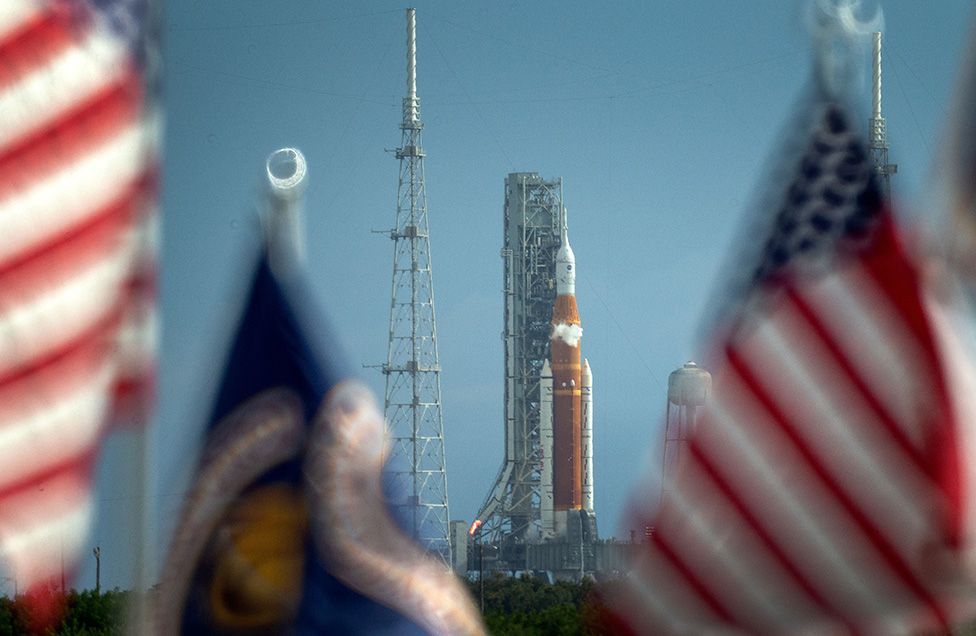
The send off of Nasa's new Artemis I Moon rocket is confronting a possibly extensive defer following a subsequent delay.
Regulators fell flat again on Saturday to get the Space Launch System (SLS) vehicle to take off. They were ruined by a fuel spill.
Designs presently need to examine the rocket, and any fixes might have to occur in the studio as opposed to on the platform.
The entire cycle is sure to prompt a mishap of half a month.
It implies we may not see a third send off endeavor before mid-October at the earliest.
The SLS is the most impressive rocket at any point created by the US space organization, and is intended to send space travelers and their hardware back to the Moon following a shortfall of 50 years.
A significant part of the tremendous push comes from consuming very nearly 3,000,000 liters of super-cool fluid hydrogen and oxygen in four major motors on the vehicle's underside.
Yet, when regulators sent the order from the get-go Saturday morning to fill the rocket's hydrogen tank, a caution went off, demonstrating there was a break.
The issue was followed to the association where the hydrogen was being siphoned into the vehicle.
Regulators attempted various fixes, including permitting the equipment to get ready for brief periods to reset the seal, yet they were not effective.
The Artemis I mission is uncrewed, however Nasa's Artemis mission director Mike Sarafin said the rocket's future job in human spaceflight implied intense consideration was as yet expected in its activity.
"This is a staggeringly hard business. This is an underlying practice run of this vehicle. As was said: we will fly when we're prepared. Furthermore, as a feature of this underlying experimental drill, we're learning the vehicle; we're figuring out how to work the vehicle," he told journalists.
His chief, Nasa Administrator Bill Nelson, concurred: "I view at this as a piece of our space program, of which wellbeing is the first spot on the list."
The flawed seal on the SLS might possibly be fixed on the platform. In any case, there are batteries in the end framework used to obliterate the rocket in case of a delinquent send off that will require recertification past this approaching week, and this must be finished in the studio.
Moving the vehicle back to the designing structure makes a third takeoff endeavor before mid-October impossible.
"To test our batteries, change out the batteries, we need to move back," said Jim Free, Nasa's partner head for investigation frameworks improvement.
Saturday's endeavor to despatch the SLS rocket had been booked for the beginning of a two-hour window starting at 14:17 neighborhood time (19:17 BST; 18:17 GMT).
The 100m-tall vehicle's goal is to fling a human-evaluated case, called Orion, toward the Moon, something that hasn't occurred since Project Apollo finished in 1972.
Realistic of SLS
Nasa had first attempted to send off the rocket on Monday. That endeavor was waved off when regulators couldn't rest assured the four major motors at the foundation of the center stage were at the right working temperature.
Frustratingly, resulting investigation demonstrated that a sensor was more likely than not yielding erroneous readings. The power units, more than likely, were in totally the right condition to go fly.
At the point when the SLS moves away, being a stupendous sight is certain.
"It will be 'transport on steroids'," said Doug Hurley, who was the pilot on the absolute last transport mission in 2011.
Media subtitle,
Previous space explorer Doug Hurley: "We're expanding on protected, able plans"
The previous space explorer currently works for Northrop Grumman who make the large white strong promoters on the sides of the SLS.
"My thought process was the coolest thing about transport dispatches was you saw it lift off and it was well clear of the pinnacle before you heard anything, and afterward it was even somewhat longer before you felt it," he made sense of.
"Push to weight-wise, SLS is very near what transport was. Apollo's Saturn V rocket was definitely unique. I never saw it face to face yet it blundered clear of the cushion. For transport, it appeared as though it was clear in a moment, nearly when the promoters were lit. SLS ought to be something very similar," he told BBC News.



Comments
Post a Comment